Metacon’s new compact 20 MW module can reduce steel module costs by up to 30%, piping and insulation costs by up to 50%, and area-related costs by as much as 70%. But how? And why is it so important?
As hydrogen projects grow in size, the space required for each MW of installed capacity becomes an important cost-driver that impacts the investment case.
Various components outside of the actual electrolyser, such as land, steel structures, piping, insulation, pipe supports, civil works and site integration all add to the total project costs. These costs become particularly significant at industrial sites where space is often limited, expensive or operationally sensitive.
This was the starting point when Metacon developed the new 20 MW pressurised alkaline electrolyser module.
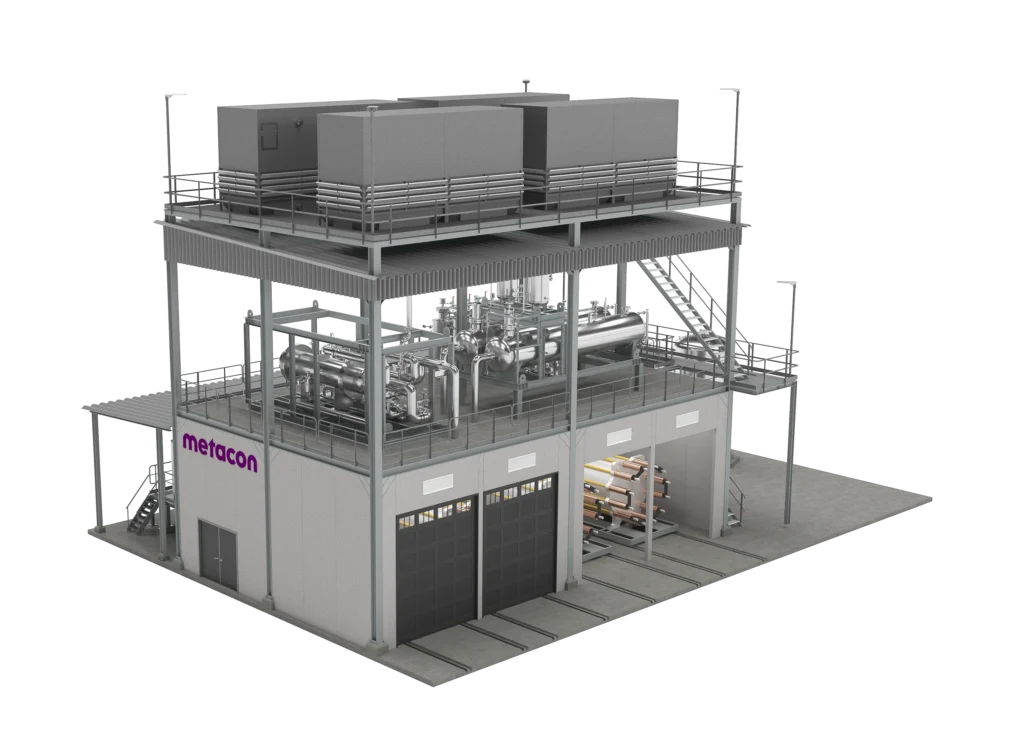
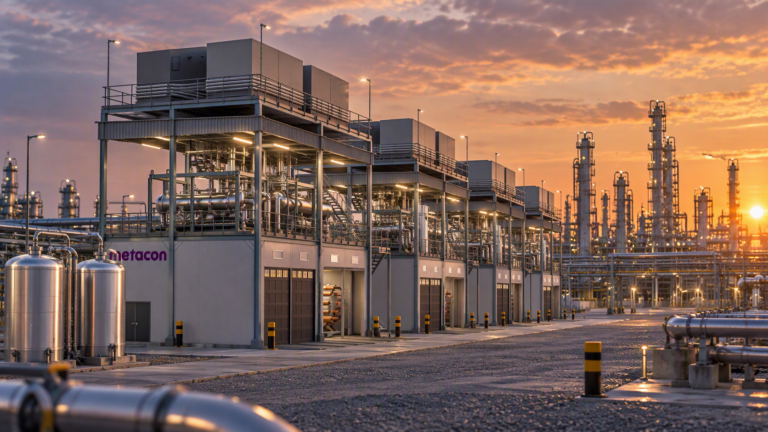
The module uses a compact multi-level configuration, with electrolyser stacks on the lower level and gas-treatment equipment and cooling units positioned above. This places more production capacity on a smaller plot while maintaining safe and practical access for operation and maintenance.
The layout also shortens process, utility and electrical interconnections. Compared with a conventional building-based installation, calculations indicate that the design can reduce the cost of the steel module by up to 30%. Piping materials, insulation, pipe supports and related items can be reduced by up to 50%, while other costs linked to the required installation area can be reduced by up to 70%. Of course, the final level of cost reduction will depend on local site conditions, project scope and final design.
The underlying principle is straightforward: a smaller installation requires less structure, less piping and less supporting infrastructure. Also, avoiding the need for a conventional factory building as part of the plant construction can significantly shorten construction time and reduce complexity and cost.
The module is designed around four next-generation PERIC pressurised alkaline stacks, capacity and cost-wise optimized and matched with a single large gas-lye treatment system. The result is a very compact and repeatable 20 MW configuration for larger hydrogen production facilities. Multiple modules can be deployed in parallel as plant capacity increases, without redesigning the basic arrangement for every project.
Lower CAPEX can make more hydrogen projects viable, since project economics are determined by the complete project business case, not by electricity consumption or stack performance alone. Equipment layout, construction requirements and integration with the surrounding industrial site also significantly affect the final cost of hydrogen production.
Getting more projects through FID and realised is essential to establish a functional hydrogen economy. Demand already exists, but deployment needs to accelerate. Each new plant strengthens the supply chain, builds engineering and construction experience and creates the scale needed to reduce equipment, project delivery and hydrogen production costs further.
Metacon’s new module is designed to support industrial applications such as refineries, ammonia production, chemicals, e-fuels, green steel and other large-scale hydrogen users. The unit should also provide an attractive option for standardized regional production for the clean hydrogen transport sector, serving the growing network of hydrogen refueling stations in many countries.
Do you want to know more? Explore the website or download the spec sheet.
You are welcome to contact us with any further questions.